
At present I’m teaching not one but two teenagers to drive. And somewhere in the midst of the shrieks and skid marks, I’ve wondered:
Is teaching my kids to drive a microcosm of the entire parenting process?
For those of you parents who’ve already done this (or if you can imagine how you’ll do it someday), I don’t know about you, but here are some things I’ve never said while sitting in the passenger seat as my teen was driving:
“You just do whatever feels best for you.”
“I just want you to be happy.”
“It’s your decision, and I’ll support you, no matter what you choose to do.”
“Don’t let anyone else tell you what you can and cannot do.”
“Follow your heart.”
“I’ll always be here if you need me.”
There are numerous reasons why I haven’t even considered saying any of these things, and all of those reasons are so warranted that I won’t rehearse them, because the bottom line is this:

My teens know next to nothing about driving.
And the little that they do know is just enough to make them dangerous; that is, it’s enough for them to entertain the thought that they might actually know how to drive: “I’ve seen it done on TV, and I’ve watched mom and/or dad do it these past 15 years… so how hard could it be?”
But as I’ve been teaching them to drive, what’s most interesting is how often I simply and stupidly expect them (1) to already know something or (2) to already know how to do something: surely they know that when you merge from one lane to another, you do it GRADUALLY, right?
Nope. Absolutely not. Not remotely.
And why on earth would they? In truth, they don’t know, nor would they have any reason to know. And YET I’ve found that for some completely stupid reason, as I teach them to drive, I can be far too passive and permissive in my parental role: surely they’ve got this.
Um, no, they really, really don’t.
In truth, from day 1 our kids are nearly clueless about what they should (or shouldn’t) do: “Don’t put that in your mouth!” “Say, ‘Thank you!'” “Look at Mrs. Smith when you’re speaking to her.” “Haven’t you been wearing that shirt for the last four days? PUT IT IN THE DIRTY LAUNDRY–NOW!!”
And when it comes to getting behind the wheel, the blindingly obvious truth is this: they desperately need to be shown (repeatedly) how to do it, and then under close supervision to do it themselves (repeatedly). In fact–and this is key:

they need to be equipped–through both (verbal) instruction and (embodied) example and execution–with a very specific skill set, if they can navigate safely to the right destination. Several observations should be made:
(1) over the years this very specific skill set has changed little, if at all;
(2) strictly speaking, mastering this skill set has nothing to do with one’s gender, ethnicity, class, etc.;
(3) only by learning this specific skill-set can they then obtain the liberty to go wherever; that is, freedom has nothing to do with their feelings about driving; freedom is found in driving not with feeling but with facility.
There is a name (at least, in classical Hebrew and Hellenistic Greek) for a mastery of, or a facility with, a particular skill-set (like driving): wisdom. In fact, both the Hebrew and Greek words regularly translated as “wisdom” could, more often than not, be fairly translated as “expertise” or “skill” (see, e.g., Exod. 28:3).
Now wisdom, when it’s passed on from generation to generation, acquires a new name: tradition. When I teach my teen–er, my teens–to drive, I am in effect passing on a particular form of “tradition.”
And here’s where things can go wrong (ha!):

If, as I’m passing along that tradition, in the midst of the very helpful wisdom being imparted, are found skills or practices that are either unhelpful or extraneous (what we might call pseudo-wisdom), they will be eventually found out. For example, if I don’t wear a seatbelt while driving, or if I put on makeup while driving (although I gave that up years ago), or if I text while driving–these can interfere greatly with how effectively the tradition will be transmitted. How so?
Well, if there’s enough pseudo-wisdom mixed in, it can cause the rest of the tradition to be called into question: it will feel unnecessarily constraining, costly, or even capricious, and, well, merely constructed.
And this is exactly where we who parent in the first quarter of the 21st-century American / Western context find ourselves: all manner of traditions, customs and norms across numerous spheres of life regarding, e.g., work, education, sexuality, gender relations, finances, friendship, etc.–have come to be doubted and even dismissed somewhere in the past 50-60 years, discredited as mere “social constructs.”
Why has this happened?
I’m not going to pretend that I know the answer–there are probably a variety of contributing factors, but here’s what I take to be a significant factor (based on reading lots of really good but really nerdy books):
We 21st-century Americans love our freedom. We place a premium on individual human choice.
After all, who wants to be told what to do?
Answer: a 15-year-old with a learner’s permit, when they’re driving in rush hour traffic.
If as a culture we cherish–worship?–individual choice, we will want that choice for others: thus, love–including parental love–begins to look like giving “the gift of choice” to our children (we’ve all been–or seen–the parent who’s asking their 2-yr-old which flavor of ice cream they want). And this choice-cherishing form of “love” most often manifests itself well-intending passive, permissive parenting:
in its milder form, it’s like assuming that our teen already knows to merge from one lane to the next GRADUALLY;
in its extreme form, it’s like tossing the car keys to our 15-year-old and saying, “Follow your heart! Don’t let anyone tell you what you can and can’t do! I’ll always be here if you need me.”

Now this hyper-prioritization and pursuit of individual human choice, free of any external hindrance, spells the death of any/all tradition. Why? Because traditions constrain: they insist that individual persons be required or compelled to learn certain skill sets and practices.
But why? Why would tradition intentionally constrain?
Well, ideally, it’s for the same reason that many parents (especially) force their teens to get a driver’s license–viz., so that their teen can have the freedom to drive themselves to piano lessons or soccer practice or that last-minute babysitting job or to a party with friends–SIGH.
But, wait, if this is true, why do we as a culture place such a high premium on individual human choice? Why do so many voices today vilify and nullify tradition?
Well, whereas good tradition (which conveys real wisdom) constrains its recipients in a way that leads to emancipation, bad tradition (which conveys pseudo-wisdom) constrains in a way that leads (whether intentionally or accidentally) to really bad things like subjugation and exploitation.
Recall from above the possibility that, when teaching my twins to drive, I could be passing on (whether intentionally or accidentally) pseudo-wisdom by, e.g., texting or putting on makeup while driving. Or perhaps out of laziness or insensitivity I required that my daughters drive my car without ever adjusting the seat or mirrors, even though they’re both 5’7″ and I’m 6’1″. Such “tradition” would be not only fruitless but fraught with danger, and how would it make them feel?
So, rather unsurprisingly, Scripture is quick both to (1) put down “human tradition”–what we might call received tradition, and (2) to pass on “heavenly tradition”–what we might call revealed tradition.
Citing the prophet Isaiah, Jesus repudiates the useless “rules taught by men”: “Having let go of the commands of God, you are holding on to the traditions of men.” Paul criticizes his “pre-Christian” self as being “extremely zealous for the traditions of my fathers.” And Peter celebrates how his readers have been “redeemed from the empty way of life passed down from your ancestors.”
And yet Scripture also urges parents to pass on a revealed tradition–“revealed” in that it was a Wisdom from Beyond, “revealed” because its Wisdom was both counterintuitive and countercultural: humanity had “hopelessly lost its way” and desperately needed a Life-giving Word. And so, as counterintuitive and as countercultural as this Wisdom was, it actually had the capacity to cultivate a community that would flourish–a community of humans who would at last be truly free.
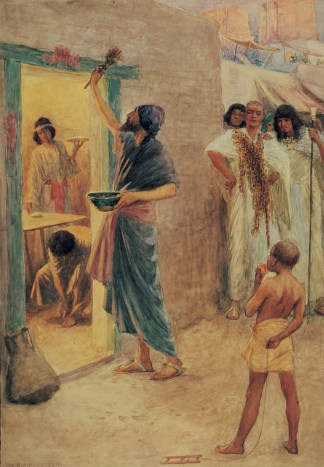
When the Pentateuch prescribes the Passover meal or when it proclaims the primary commandment of the Shema (which Jesus would call the greatest commandment), it speaks immediately of parents passing on to their children the interwoven Stories and Stipulations central to God’s people. Not only does Paul instruct parents to raise their children “in the training and instruction of the Lord,” he speaks more generally of the Christian’s responsibility to “receive that which was passed on to him,” and instructs Timothy to pass on what Paul had taught him to others who would in turn pass it on to others.
Indeed, to be a Christian is to be a disciple of Jesus–i.e., to be under Jesus’ “discipline,” or training.
As Christian parents, we actively pass on a tradition: the Scriptures are like an heirloom, an ancient and exotic tapestry of prose, prescripts, practices and proverbs that reveal a highly counterintuitive, countercultural and yet ever so compelling way to life, both now and forever.
But the choice-cherishing form of parenting of our day tends to be both passive and permissive: it often has the immediate benefit of high approval ratings from kids–imagine the excitement of the 15-year-old whose parent simply hands them the keys to car and says:
“You just do whatever feels best to you. I just want you to be happy.”

Of course, even as they attempt to drive out of the neighborhood, their excitement gives way to a hidden anxiety. And as they attempt to merge onto the highway in the morning rush hour, their anxiety intensifies into alarm, as they do their best to pretend to know what the hell they’re doing.
Is it any coincidence that today our teens and twenty-somethings are exhibiting unprecedented levels of anxiety and depression? When we unintentionally and/or indirectly communicate to our kids that “Life is up to you!”, it may at first feel freeing for them, but in time it leaves them fettered with fear, fatigue, and the feeling that they’re probably missing something–because they almost certainly are.

When we “free” our kids to think, say, and do whatever they (think they) want, we actually enslave them to the drawbacks, doldrums, not to mention the depravity, common to adolescence. Unwittingly, we consign them to the very limited horizons of their known proclivities, pastimes and passions. We confine them to the echo chamber of their (understandably) oversimplistic and makeshift outlook on the world, until that echo chamber coldly collapses under the overwhelming external pressure of something called Reality.
Some years ago a twenty-something told me how throughout junior high and high school her father was delightfully permissive about whatever she wanted to do. Living mostly with her father after her parents’ divorce, she said, “For most of my teen years I was thrilled that my dad didn’t care what I did–I was the envy of my friends: I could go wherever, wear whatever, and hang out with whomever I wanted. But somewhere in my senior year, when the consequences of a number of bad decisions on my part really hit home, and the shame, guilt and regret set in, it suddenly hit me in a whole new way: my dad really didn’t care. And that’s when I realized: when staying with my dad, I was on my own.”
A final story: Recently while one of my daughters was driving, with me in the passenger seat, another car suddenly–and very dangerously–cut her off. Right a way she cried out, “Dad?!!” I immediately, calmly but firmly said, “Sweetie, BREAK!” As I grabbed the wheel and veered us into the shoulder, she slammed on the breaks, and an accident was avoided. We pulled off the road and parked for a minute to gather ourselves.
Somewhat shaken, we sat there in silence.
“Thanks, dad, for telling me what to do back there.”
“No, thank you for listening, sweetie.”
———-
Got questions? Ask away! Enjoy this post? Leave a comment!

 Hope Unbroken
My kids are 10 and 13 years old and the thought of them behind the wheel is heart-stopping: one is cautious and hesitant sometimes and the younger is incredibly impulsive and both are so easily distracted or zoned out.
I am so often “assume” my kids know x,y, and z or should be able to think through a simple moment like “take out the trash… no All of the trash….upstairs and downstairs…did you get the bathroom?. Yes, the cat box too”. I often feel like I have to spell things out for them. So thank you for reminding to be patient with them because the really don’t know.
I have said, “I just want you to be happy, I’ll always be here if you need me (though I have also said someday we won’t be here to help, and I’ll support your decision but I sometimes limit the choices.”
The quote, “And the little that they do know is just enough to make them dangerous; that is, it’s enough for them to entertain the thought that they might actually know how to (fill in the blank with anything here, it still applies)” is so very true. Especially so of my teen.
I thought it was a good idea to provide kids with choices, even simple ones so they learn how to make choices and live with the consequences? Any up the decision difficulty as they mature? PLs note I stink at this. I was very controlling when they were younger and now feel they struggle with choice and consequence. One last observation, my mom was very controlling and made many decisions for me or routinely said, “You won’t like that, you’ll regret that, that’s a waste of money, get the other color instead, etc.” As (I think) a result…, when I did get out on my own, I need to get an approval or “ok” from someone before I could make a decision. And then a similar cycle seems to start. I suspect I’m missing something here. Can you clarify? Thank you.
Lastly, I promise, now that I’m in my 40’s, I wish my family had more “traditions” while I was growing up. Looking back, I wish we had more family culture and tradition when I was growing up. Present day: By being more connected with friends and my husband’s family I have learned or picked up on other family traditions/culture and/or been included in theirs and its a wonderful experience. Thank you for posting this blog.
Best regards
Really great thoughts!!
To stay with the metaphor of driving, the goal of parenting is neither (1) to be passive (“Here are keys–have fun!”) NOR (2) to be controlling (“You sit in the driver’s seat, but I’LL control the wheel–hands off!!”). Rather, the goal is the imparting of SKILLS, through (1) our daily example (“See how much distance I keep in front of the car in front of me?”), (2) our detailed and repeated instruction (“Slowly, let off the break, but keep your foot just above the break, just in case…”) and (3) and repeated execution (“In this parking lot, I want you to swerve back and forth repeatedly to get a feel for the wheel”).
Neither passive parenting nor controlling parenting imparts skills. The example you gave of taking the trash out (which is an example of learning the skill of work) is a great one: (1) example: as parents, we work diligently and thoroughly; (2) instruction: we provide detailed instruction, going through it repeatedly and having them repeat it back to us several times, so there’s an abundance of clarity re expectations, realizing it may be an iterative process (“Oh I forget to tell you about the kitty litter”); (3) execution: we have them model it for us repeatedly before we set them loose. We may attach Scripture to it–e.g., Prov. 18.9: “One who is slack in his work is brother to one who destroys” or Pr. 10.4: “Lazy hands make a man poor, but diligent hands bring wealth”–i.e., it’s not intelligence but diligence that will in time pay off.
Your mom’s comments like “You won’t like that, you’ll regret that” do in fact have their place: it’s good to warn and woo our kids. BUT, generally speaking, we humans–and especially as kids–aren’t very rational beings: in the face of a rational argument, we may well do what we want anyway. If I’m just talking with my kids, I will certainly use logic and rationality. But when I’m directing my kids to do something, I can/should expect them to do it simply because I’m the parent: I love them, want what’s best for them, know way more than them, and am responsible for them. There’s no one else on this planet who is more for them. If they’ve momentarily lost sight of that, I can’t help that–ha!! We parents are to be unapologetic in showing our children how to do this thing called life: our kids don’t know what’s at stake, we do.
Yes, family traditions are so beautiful!!
I’m sure these thoughts are too simplistic, but I hope they help a bit!
Thank you