
“The wrath of the Lamb.”
It’s one of the most striking phrases in Revelation–that puzzling last book of the New Testament.
The phrase is evocative, not to mention unsettling. And it communicates one key facet in Revelation’s truly awe-inspiring portrait of Jesus–think about it: a lamb, a pure and powerless recipient of divine wrath, becomes its agent.
Here’s the immediate context of the phrase in Rev. 6:
“Then the kings of the earth, the princes, the generals, the rich, the mighty, and everyone else, both slave and free, hid in caves and among the rocks of the mountains. They called to the mountains and rocks, ‘Fall on us and hide us from the face of him who sits on the throne and from the wrath of the Lamb! For the great day of their wrath has come, and who can stand?'”
When will “the wrath of the Lamb” come? The text is explicit: on “the great day of their wrath.”
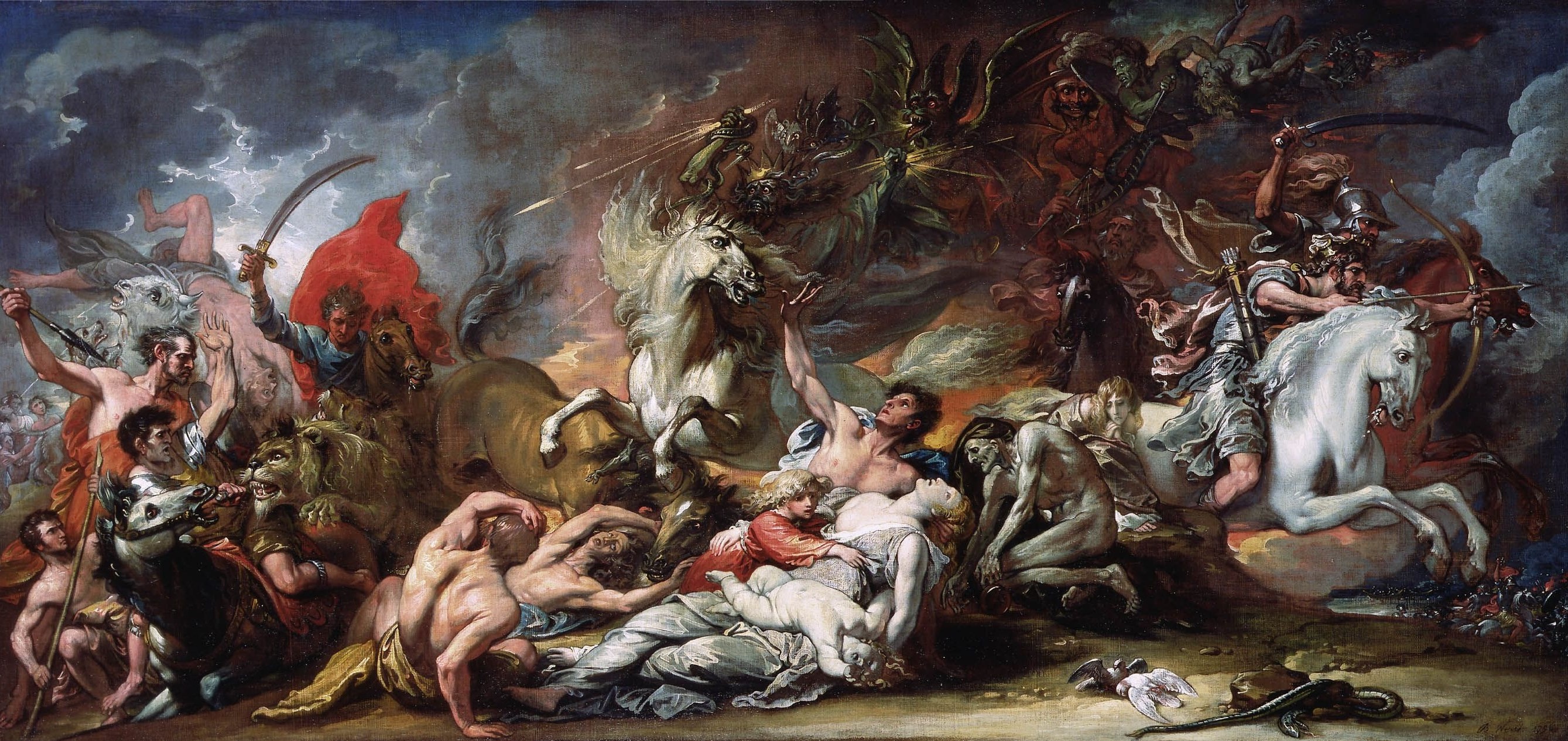
This is important, because this climactic event of divine wrath–the sixth “seal” in a series of seven–is therefore qualitatively different from the events that precede it, especially the first four “seals,” which, when opened by the Lamb, unleash the famous four horsemen of the Apocalypse.
Sent upon the earth by the Lamb, these horsemen are harrowing agents of war, savagery, economic collapse, famine–and, yes, plague.
Damnation vs. Destabilization
But how are these catastrophic events, ordained by God and implemented by the Lamb, different from the coming “great day of their wrath”?
The final, decisive event ushers in final damnation, while the prior occasional events initiate national and international destabilization.
And there’s a world of difference between the two.
If in Revelation the blood of “the Lamb that was slain” speaks of Christ’s once-and-for-all atoning grace for all who know they need it, these four agents of international destabilization speak of Christ’s ongoing, interrupting grace for all who don’t (yet) know they need it.
That may sound altogether absurd, even demented: Jesus actually sends war, civil disorder and violence, economic disaster, famine and pestilence in order to “destabilize”? And what exactly do we mean by “destabilize”?
True to the central aim of Revelation, crises and calamities are themselves times of great revelation: they reveal the otherwise hidden limitations and weaknesses in…well… just about everyone and everything–in long decaying institutions of power (e.g., government or higher education), in false sources of security (e.g., the stock market) or identity (e.g., a job), in flailing sources of expertise (e.g., news media, scientists or public health officials), in our communities (e.g., law enforcement, schools, or churches) and, not least, in ourselves (e.g., exhaustion, anger, division, despair, regret, etc.).
In his amazingly in-depth and insightful chronicle of how AIDS ravaged gay men in the final decades of the 20th century, Andrew Sullivan, arguably one of the most influential political and cultural commentators of our time, writes of the debilitating effects of AIDS and its impact upon its victims’ outlook, generalizing, “Plagues and wars do this to peoples. They force them to ask more fundamental questions of who they are and what they want” (Love Undetectable: Notes on Friendship, Sex and Survival, p. 66).

And it’s precisely these revelations that bring about re-evaluations of (once again) just about everything and everyone: institutions, collective and personal values and priorities, affiliations and relationships are all reconsidered, now seen from a totally new (if tough or even tragic) vantage point. Specifically, their limits and weaknesses leave us looking for something more, something better–a more enduring hope, a more reliable source of security, identity, etc.
And Jesus thinks that’s a very, very good thing.
But these times of conflict, crisis and calamity reveal not only the otherwise hidden failings and limitations of humans institutionally, collectively and individually, they can also reveal the otherwise hidden faithfulness of God’s people: when the Lamb opens the fifth “seal,” John beholds “under the altar the souls of those who had been slain because of the word of God and the testimony they had maintained.”
Here in Rev. 6 fidelity is found in response to persecution but, as the (so-called) plague of Cyprian in the third century powerfully exemplifies, it can also be found in response to both persecution and plague.
The Plague of Cyprian
By the end of the second century, it is estimated that Christians were a meager 100,000ish in number. They make little or no appearance in the public record (as we have it) up to that point. But over the next century Christianity would expand–rapidly, as evidenced by the impressive spread of personal names that were unmistakably Christian. As one exceptional historian of the period, Kyle Harper, states, “the unavoidable conclusion is that the third century witnessed the explosive transformation of Christianity into a mass phenomenon.”
But what caused this transformation? A number of factors to be sure, but an important factor was a plague that ravaged the empire from the late 240s to the end of the following decade, a plague for whom our primary source is a bishop of Carthage by the name of Cyprian, martyred in 258, some 12-13 years after his conversion, yet not before he could become arguably the century’s most significant church figure.

What were the religious ramifications of the plague? To quote Harper at length:
“The mass mortality [from the plague] painfully showed up the inefficacy of the ancestral gods and put on exhibit the virtues of the Christian faith…. Christianity’s sharpest advantage was its inexhaustible ability to forge kinship-like networks among perfect strangers based on an ethic of sacrificial love. The church boasted of being a ‘new ethnos,’ a new nation, with all the implications of shared heritage and mutual obligation. Christian ethics turned the chaos of pestilence into a mission field. The vivid promise of resurrection encouraged the faithful against the fear of death. Cyprian, in the heat of persecution and plague, pleaded with his congregation to love the enemy. The compassion was conspicuous and consequential….
“Once the fire of crisis was burned out, its ashes left behind a fertile field for Christian expansion. [Emperor] Gallienus called a halt to the persecution in AD 260…. The famous church historian, Eusebius, triumphantly described these days of unhindered growth. ‘How does one describe those multitudes worshipping and the throngs pressing together in every city and the brilliant assemblies gathered in prayer? Indeed because of these crowds the old buildings no more sufficed for them, and spacious churches were built from the very ground up in all the cities.'”

He concludes: “By the turn of the fourth century, the Christian community had become a force to be reckoned with.”
Praying for destabilization?
Moving to the eleventh chapter of Revelation, we find the people of God symbolically depicted first as “the temple of God” (a common NT metaphor of the church) and then as “two witnesses” who “will prophesy…, clothed in sackcloth.”
This a powerful and highly instructive depiction of the church: the witnesses are two, in order to communicate the sufficiency of their witness; they prophesy, because they call the world to repentance; they are clothed in sackcloth, because their hearts break for how lost, lonely, and enslaved the world is. In sum, the church neither condemns nor condones sinners but rather humbly and tearfully calls them to repentance.
But these witnesses do more than prophesy. They pray–powerfully. This is amazing:
“They have power to shut up the heavens so that it will not rain during the time they are prophesying; and they have power to turn the waters into blood, and to smite the earth with plagues, as often as they want.”
The first “power” recalls the prophet Elijah’s prayer for drought to destabilize a disobedient people of God. The second “power” recalls Moses’ petitions for the plagues, to destabilize a defiant pagan nation. The people of God, says Revelation, have the “power” to pray for God to send earth-shaking events that will awaken, e.g., sleepy suburbanites, whether they’re quasi-Christian or could care less about Christianity.
But what’s the goal?

Just as the plague of Cyprian destabilized the Roman Empire, revealing the fragility and fantasy that was the pax romana, so also the catastrophic events of our own day can destabilize the American Empire, revealing the fragility and fantasy that is the pax americana, so that all might see the beauty and invincibility of the gracious reign of the Lamb, that is sure to overtake the world, as the seventh trumpet angel declares:
“The kingdom of the world has become the kingdom of our Lord and of his Messiah, and he shall reign for ever and ever.”
Amen. Come, Lord Jesus.
Featured image: “Plague in Rome” by Jules-Élie Delaunay (1869) – Josse, Leemage, Getty

 Hope Unbroken