
It seems like everywhere I turn, I learn of fellow sisters and brothers in conflict with one another.
It’s actually not true, but it sure feels that way. I know it’s not true, because I can look at a number of churches who by God’s grace have prayerfully, graciously and wisely navigated a number of dicey issues, especially over the past year and a half.
It seems to me that when I am in conflict there’s one truth that I so quickly and repeatedly lose sight of:
Knowing who the enemy is.
I regularly misidentify the enemy as my spouse, my kids, my fellow church leaders (or laity), brothers or sisters in the Lord who disagree with me, non-Christian voices or movements within our culture, this or that politician, corporate executive, author–the list could go on.
But incredibly Paul says that actually these persons–every last one of them–are not my enemy. Nor can they ever be. When calling the Christians in Ephesus to ready themselves for spiritual warfare, he states (and I translate woodenly):
“…for us the struggle is not against flesh and blood.”
Paul radically redraws the battle lines “for” the Christian: while it may be true for those outside the family of God, “for us” Christians the conflict is truly never against any other human being (“flesh and blood”).
Period.
Our Shared Humanity
Here is, in my opinion, a truth long forgotten today: according to Paul, the very fact of our shared humanity–that we, every last one of us, are “flesh and blood”–prevents us from regarding other humans as enemies.
This is staggering, especially in today’s “cancel” culture.
In their NYT bestseller The Coddling of the American Mind, Greg Lukianoff and Jonathan Haidt argue that one of three “untruths” widely taught on university campuses is that “Life is a battle between good people and evil people” (ch. 3). They further contrast two kinds of identity politics: common-humanity identity politics (as championed by MLK) and common-enemy identity politics (which, they argue, is pervasive across the political and ideological spectrum today, but often found on college campuses in the form of Kimberlé Crenshaw’s theory of intersectionality).
Brilliantly Paul’s perspective combines the best of both–the radical inclusivity of common-humanity identity politics (no “flesh and blood” is my true foe) and the unifying power of common-enemy identity politics–for Paul will go on to speak in no uncertain terms of whom our struggle is against–namely, the Evil One and his legions (that’s for another blog post).
The very fact that Paul has to state specifically who our foe isn’t indicates how easily we can misidentify the “bad guy.”
Both military and civilian airports (and some aircraft) use a radar system for identifying approaching aircraft called IFF (Identification Friend or Foe). The system’s obvious function is to enable an early and appropriate response to unknown approaching aircraft. Paul’s words suggest that we humans–and, no less, we Christians–have an internal IFF system that routinely malfunctions, confusing friend for foe. And, as one might expect with a malfunctioning military IFF system, so also with us: the resulting casualties are massive.
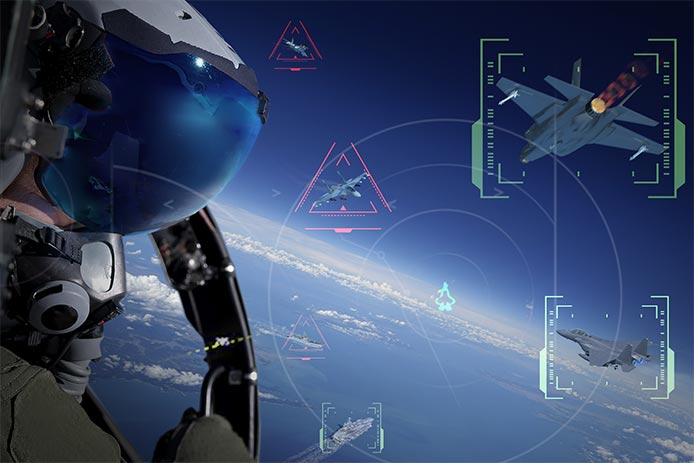
That is, when we misidentify friends as foes, the result is almost inevitably friendly fire. And friendly fire is tragic for everyone involved.
Our Shared Christianity
If, for Paul, the fact of our shared humanity prevents us from regarding one another as enemies, how much more our shared Christianity. Earlier in his letter to the Ephesians, urging them to “eagerly keep the unity of the Spirit through the bond of peace,” he lists all that unites fellow believers: For each and every one of us there is…
– “one body”: that is, we are all members of the one body of Christ; when Christians see one another as enemies, it’s the spiritual equivalent of an autoimmune disease in which one part of the body starts attacking another;
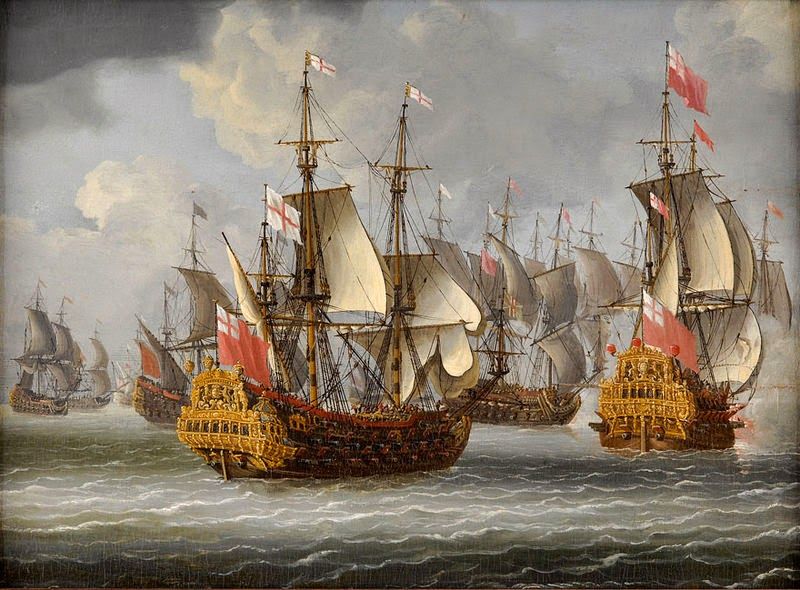
– “one Spirit”: there’s one animating, unifying power that–or, rather, Who–indwells us all; when Christians see one another as enemies, it’s like a large fleet of wind-powered naval vessels driven along by a single westerly wind suddenly breaking close formation and independently choosing their route–with disastrous (and self-defeating) results;
– “one hope”: Christians in conflict can lose sight of the fact that one day they will take their places together at the feast with Abraham, Isaac and Jacob in the kingdom of heaven;
– “one Lord, one faith [or, more probably, allegiance]”: we all belong to and take orders from–and will be judged by–only one Master; as Paul asks elsewhere, “Who are you to judge someone else’s servant?”; Christian in conflict are tempted to sit in the judgment seat that belongs only to Christ;
– “one baptism”: we all have been completely cleansed from our sins, fully included in his family, and consecrated for his service, according to the one shared sacrament;
– “one God and Father of all, who is over all and through all and in all”: here the fourfold “all” highlights that the Father does not differentiate among His children: as for the brother or sister with whom I disagree, the Father regards them as His child no less (or more) than me. In short, our Heavenly Father doesn’t play favorites.
Our Shared Ministry
But, finally, not only should our common humanity and our common Christianity prevent us from seeing each other as enemies, but (for those of us in ministry) our common ministry ought to do the same.
There is a passage in Paul’s letter to the Philippians that has been an endless source of much needed comfort and conviction. Writing from prison, Paul speaks of two groups of ministry brothers, who are distinguished (i) by their differing motives for ministry and (ii) by their differing responses to Paul’s imprisonment:

(i) one group of ministry leaders preaches Christ “out of envy and rivalry” and “out of selfish ambition, not sincerely,” while the other group does so “out of good will [i.e., in a spirit of collaboration and cooperation]”;
(ii) this second group recognizes that Paul was imprisoned “for the defense of the gospel,” while the former group sees Paul’s imprisonment as an opportunity to add insult to injury: while Paul was in prison, they threw him under the bus.
Paul’s response is amazing. The NIV’s (and NRSV’s) paraphrastic translation captures the Greek well, as Paul asks the all-important question:
“But what does it matter?”
Isn’t that the million-dollar question? Doesn’t hypocrisy or false motives (like “selfish ambition”) in ministry leaders matter? Doesn’t Paul’s reputation matter?
But what matters most to Paul–i.e., “the important thing”–is that “in every way, whether from false motives or true, Christ is preached, and in this I rejoice.”
Again, this is staggering.
Since I’m a minister, Paul’s words have regularly provided ample opportunity for self-examination:
(i) What are my motives for ministry? Am I cooperative and collaborative, or am I competitive, envious, ruled by selfish ambition?
(ii) How charitably (or uncharitably) do I interpret others’ ministries (and ministry hardships)? Do I assume anything less than the best of them? Do I entertain hearsay and gossip? Do I heed Paul’s insistence to “not entertain an accusation against an elder unless it is brought by the testimony of two or three witnesses” (1Tim. 5.19)?
(iii) Do I allow for ill-motive, insincerity, and self-ambition in other ministers? Do I believe that Christ uses deeply flawed persons (like me?) to proclaim His gospel? Can I even rejoice in the fact that “Christ is proclaimed” through their ministries?
(iv) When I’m misrepresented or slandered by other ministers, how will I respond? Will I make it all about me? Will I be able to answer accurately the all-important question, “What does it matter?”
When in conflict with other Christians, these questions have been liberating, helping me to redraw the battle lines in the way that Paul calls us to do. They move from being enemies to being allies, united in battle as a band of brothers.
And, undoubtedly, brothers will at times bicker and brawl. But they will also band together against a common enemy.
Speaking of a band of brothers, in the brilliant HBO series Band of Brothers there’s a moving scene, in which a German general who has surrendered to 101st Airborne’s E (or “Easy”) company requests permission to address his troops one last time. As the soldiers of Easy Company overhear the general’s speech to his men, they are unexpectedly but deeply moved, realizing they have far more in common with their German adversaries than they ever realized.
Would that we embattled Christians might do the same.
Check it out (ignore the misspelling at the beginning!):

 Hope Unbroken
So good, Bruce! Love the way you break down and explain Eph 4!