
What’s at stake this election season?
Overwhelmingly, the American news media would be inclined to say, “Pretty much everything.” And many Americans, whether progressive or conservative, would say the same:
We need the right president, with the right policies, nominating the right Supreme Court justices, if America (and, in turn, the world) is to flourish. Conversely, electing the wrong president will surely be the tipping point for a social and economic apocalypse.
So getting the right person in the oval office is what it’s all about.
And if this really is true, it’s little wonder why America is so polarized (and perturbed): the vehemence and vilification, the refusal to compromise and the rise of the “cancel culture”–these are all very understandable, perhaps even necessary measures.
And within this framework it’s little wonder that the POTUS and/or SCOTUS is either demonized or idolized: their every policy, position, perspective, participle and preposition are said to impact every man, woman and child, bringing either deliverance or devastation–why?
Because (almost) everything’s at stake.
But according to the aged and incarcerated Apostle John, this is all a lie. In fact, it’s a lie that is–literally–from the pit of hell.

Capturing what he “saw” while “in the Spirit,” John writes of the “Revelation” he had of Jesus Christ, declaring (in the opening verses) that this Jesus is “the ruler of the kings of the earth”–an altogether sweeping political claim, which in his day could very well shorten one’s life expectancy.
And in the remainder of the 22 chapters John has much to say in terms of politics. Consider, e.g., chapters 12-15.
In chapter 12 John pulls back the curtain of human history to reveal that, underlying all human conflict–whether interpersonal or political–is a hidden, deeper cosmic conflict.
Importantly, in John’s vision of this cosmic conflict the Evil One is depicted as a predatorial dragon-like serpent. Throughout much of the Ancient Near Eastern and Greco-Roman worlds a serpent symbolized craftiness and cunning: to the naked eye, a serpent’s movements seem unpredictable and arbitrary, thus concealing its actual aim and intent. Given the unmistakably predatorial intent of the serpent here in Revelation, this “cunning” is used for ill–i.e., to wage war against God’s people–“those who keep God’s commands and hold fast to the testimony about Jesus.”
But just what does the Evil One’s campaign of deception actually look like? Well, that’s what chapter 13 is all about: far from being some Hollywood CGI spectacle or some farce of fundamentalist “Christian” fiction, John describes a satanic ploy that is in no way sensational but in every way structural and systemic: the Evil One, says John, hijacks the very institutions of human culture. There’s nothing to laugh about here.
Christian, sit up and pay attention.

In ch. 13 John beholds two “beasts”–creatures so called precisely because of their predatorial and wild (i.e., undomesticated) nature. True to their symbolic significance in the Old Testament, these two “beasts” symbolize cultural institutions that have been hijacked by the Evil One in his campaign of deception against God’s people.
We humans think that we can domesticate human institutions and make them our pets, all in the service of our “pet” political project, in the same way that my kids go to the St. Louis zoo and want to take home the various “cute” predatorial animals to be their pets. Right.
But wait, just which institutions is John talking about?
True to the symbolism of the prophet Daniel, the first “beast” represents political power–specifically political power asserted in the midst of unfamiliar and impersonal forces (symbolized by the “sea”)–e.g., catastrophes like natural disasters or, well, um, pandemics. It claims an absolute or ultimate–i.e., divine–power that promises a comprehensive protection and peace, a protection and peace on par with God’s.
Hijacked by the Dragon, political power pretends to have “broken the code” to bringing healing to the world’s mortal ills: “One of the heads of the beast seemed to have a fatal wound, but the fatal wound had been healed.” Wow, most impressive. The hardly surprising result: “The whole world was filled with wonder and followed the beast.”
Christian, whether you’re progressive or conservative, John wants you to understand this: in his campaign of lies, the Evil One wants the world, and especially the church, to believe that government is a god that can get us back to the garden.
(This is for another post, but I understand the second beast to represent what we today would call pop culture, along with the press and the professoriate. When hijacked by the dragon, these institutions exist primarily to promote and validate the pivotal role played by the first beast’s power. Think about it: how often do voices in the press or professoriate extol non-governmental solutions to the ills of our society?)
And here’s a practical “litmus test” for how we Christians can discern if we ourselves have believed this lie:

Have we become so convinced that everything is at stake come November that…
(1) we’re willing to distance ourselves from dissenting Christians in disdain and even derision, so that we’re functionally, or even formally, divided and no longer in fellowship with them; or…
(2) we’re regularly depressed over the political situation in our country; or…
(3) we’re distracted from what are far more pressing issues in our immediate lives–e.g., sacrificially caring for our fellow Christians, family members, friends, neighbors, etc.?
In short, to the extent we’ve given in to division, depression and distraction, we’ve given in to the deception of the Evil One.
But someone might object:
Doesn’t all of the above fail to assign a sufficient gravity to the pressing issues of justice facing our culture? A progressive Christian might insist that grave matters of racial justice demand that we divide, while a conservative Christian might insist that grave matters of justice for the unborn and aged demand that we divide.
Both are wrong, and here’s why.
Unmistakably, the Bible considers these (and other) matters of justice as first order: one cannot read Old Testament Law or the prophetic admonitions and conclude otherwise; a (perhaps even the) central mission of God’s people is the “doing” of “justice and righteousness”–that is, the pursuit of equity and peace in the social, economic and legal spheres (see, e.g., Gen. 18.19). Jesus said, “Blessed are all who hunger and thirst for righteousness [or, better translated, justice]….”, and he chides the religious leadership of his day for neglecting “the most important matters of the law–justice, mercy, and faithfulness.”
But while these matters of justice are indeed first order, the matters of political policy related to them are, at best, third order. Why? Because the “cure” for these injustices is not primarily political in nature. Before political policy, Scripture prioritizes (1) the central mission of the church (in terms of edification and evangelization) and (2) ministry to and the mobilization of a church’s local communities to alleviate affliction and inequity (see, e.g., 1 Peter).
This perspective challenges both conservative and progressive Christians: to risk stereotype, whereas conservative Christians are tempted to assign too little importance to matters of justice (seeing these matters as lower than first order), progressive Christians tend assign too much importance to matters of political policy (seeing them as higher than third order).
Policy is unquestionably important. But, says John, is hardly pivotal. And church history demonstrates this very thing:
In the first three centuries after Christ, political authorities either ignored, insulted or attacked the church. One can read the early 2nd-century correspondence between the regional governor Pliny the Younger and the emperor Trajan, which describes the disdain that both leaders had for Christianity; Pliny laments that the “contagion” of Christianity was demographically diverse (frustratingly so) and “has spread not only to the cities but also to the villages and farms.”

Clearly, adverse political policy was not preventing the mission of the church, in terms of both spiritual redemption and social and ethnic reconciliation.
But even before this–in the pages of the New Testament itself–we find an impressive ethnic, cultural and social diversity among the earliest Christians. Almost in passing, the book of Acts states:
“Now in the church at Antioch there were prophets and teachers: Barnabas, Simeon called Niger, Lucius of Cyrene, Manaen (who had been brought up with Herod the tetrarch) and Saul” (13.1).
Consider these leaders: The first and last persons, Barnabas and Saul (or Paul), are both Jewish ethnically. But whereas Barnabas was from Cyprus (and had relatives in Jerusalem), Saul/Paul was from the very Hellenized and highly intellectual city of Tarsus; culturally, they would have been very different. Most likely “Simeon, called Niger” is “called Niger”–which in Latin means “black”–why?–because he was of African decent. Lucius is “of Cyrene,” a Greek city in northern Africa. Finally, there’s Manaen, who stands out for his uniquely high social status by virtue of his affiliation with no less than Herod Antipas, the youngest son of Herod the Great.
Thus, “in the church at Antioch” approximately 15-20 years after Jesus’ crucifixion, we find results of the power of the gospel to generate an ethnically, culturally and socially diverse body of leaders in one of the largest cities in the Roman Empire, all without the help of a single political policy.
Finally, an example par excellence from 20th-century America. In his book A Stone of Hope: Prophetic Religion and the Death of Jim Crow (UNC Press, 2005), regarded as one of the most important works on the civil rights movement (see here), David Chappell states:
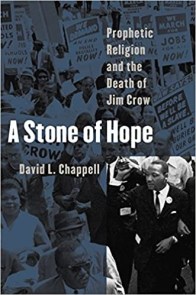
“The black movement’s nonviolent soldiers were driven not by modern liberal faith in human reason, but by older, seemingly more durable prejudices and superstitions that were rooted in Christian and Jewish myth. Specifically, they drew from a prophetic tradition that runs from David and Isaiah in the Old Testament through Augustine and Martin Luther to Reinhold Niebuhr in the twentieth century.”
Chapell, a non-Christian, devotes an entire chapter to arguing that the civil rights movement was a “religious revival,” comparing it to the “Great Awakenings” in American history. (Importantly, he then devotes another full chapter to the many failures of the church in the South.)
So how significant was the social and political impact of those whom God used to bring about this awakening?
He concludes, “Measured by historical standards of realism, their achievement was extraordinary–arguably the most successful social movement in American history, one that has been an inspiration from Soweto to Prague to Tiananmen Square.”
In sum, the “most successful social movement in American history” was at bottom a “religious revival,” rooted in “Christian and Jewish myth” (ha!), that then brought about sweeping changes in political (i.e., judicial and legislative) policy.
So are matters of injustice and oppression important? Both the Law and the Prophets say as much: they are matters of the first order. But the political policies addressing them are, at best, third order, again preceded (1) by the central mission of the church and (2) ministry to and mobilization of its local communities.
To think otherwise is to give in to the lies of the Evil One and to give way to division.
To conclude, in the midst of the cosmic conflict of Rev. 12-15, John beholds an arresting symbol of the church: a woman, “clothed with the sun, with the moon under her feet and a crown of twelve stars on her head; she was with child and cried out, in travail and torment, to give birth.” Here the church is portrayed as a source of light and life–always at great cost to herself.
In her suffering she brings forth “a son, a male child.” Whereas in the thought-world of the Old Testament a woman symbolizes the ideals of fidelity and fertility, an infant son symbolizes the promise of a new era of peace and provision. Citing Psalm 2, John makes it clear that this altogether unique child is the One “who ‘will rule all the nations with an iron scepter.'”
Psalm 2 is perhaps the surest defense against the deception of the Enemy’s lies, providing an immediate antidote to the Christian’s recurring bouts of division, depression, and distraction. For it is a song of loudest defiance and derision, daring the rulers of the earth to “do their worst” while declaring blessing for all–Jew or Gentile, slave or free, small or great–“who take refuge in him.”
Check it out:
“Why do the nations conspire
and the peoples plot–in vain?!
The kings of the earth take their stand,
and the rulers gather together
against the LORD
and against his Messiah…
The One enthroned in heaven laughs;
the Lord scoffs at them…
Therefore, you kings, be wise…
Kiss the Son, or he will be angry,
and your way will lead to your destruction…
Blessed are all who take refuge in him.”

 Hope Unbroken
Excellent article, Bruce!! So well thought out and analyzed!
I love this blog! I am going to have spend some time unpacking it (as well as the subsequent one you posted), because it is so dense and thought provoking. Just when I think I understand it, I have more questions.
But here is one question – at the risk sounding pretty ignorant. So I get that we should not believe the lie that government can get us back to the garden (a lie I find myself slipping into time and time again). And justice is a first order priority. Then, you say that the policies to effect justice are a third order priority (at best). You also, however, point to scripture to say that Christians are called to motivate the community to alleviate oppression and inequities (promote justice).
So, in present day America, we are a democracy, unlike the situation in Biblical times. The people, including Christians and nonChristians alike, have a significant voice in forming the policies or electing people whom one believes will form just policies (unlike Paul and the other believers at the time). And we know from scripture that one role of government is to hold back or stem evil. So would that be one way that Christians might be called to motivate the community – through elections- to address oppression and inequities. Could that make elections/policies more important in our day and age, because we have more of a responsibility than did the believers in Biblical times?
Also, on a super practical note — I find myself not getting depressed or distracted, but very confused about the upcoming election. (I find myself probably in the minority here as most people I know either hate Trump or love Trump or are either very conservative or very liberal.) I see many things I absolutely agree with and many things that I believe are very distasteful, even wicked. So in light of scripture, how do we sort all this out? If the policies and the election are more of a third-order priority, do I just do my best in casting my vote, but not get too worked over it because in the end we take refuge in the Lord and just leave the final outcome to him?
My questions are not really that well thought out. I need to spend more time thinking and digesting your blog. Super analytical. You did a great job, Bruce!!!
Ann-Marie (a different AnnMarie than the first person who posted). 🙂
Hi, Ann-Marie, these are great reflections. Undeniably the “shape” of the political structures of the first-century Roman world is drastically different from our own, at least in the global West and especially in America. As a result, the “average” person’s involvement in those structures is very different.
That being said, in both contexts the ideal was that there would be maximal participation by the “average” person (allowing for the fact that, in the first century, the participation of a slave was very different from that of a citizen). While the Roman citizen didn’t of course vote for the empire (ha!), he was nevertheless expected to contribute significantly to the public good–e.g., (1) giving homage, even worship, to the Empire or even the emperor himself, as well as to the many political authorities underneath him; (2) contributing to various public works (the building of an aqueduct) and/or public events (the Romans had countless sacred festivals, holidays, commemorations, etc.), many of which had gods or goddesses associated with them. Obviously, both of these forms of civic participation were problematic for Christians. But, encouraged by the New Testament (especially 1 Peter), they soon learned to engage in acts of civic generosity and justice in ways that were true to their allegiance to Jesus Christ (e.g., the rescuing of infants regarded as unfit or unwanted and then left in the elements to die).
But as you rightly point out, this participation didn’t involve the formulation of policy, much less the selection of leadership. In this sense the American citizen’s participation is greater and, thus, weightier, so, yes, perhaps when it comes to matters of curbing injustice, we have a greater responsibility.
Yet, for all the differences between the first and 21st centuries (in terms of political structures and political culture), the nature of political power hasn’t changed: it is so limited in its ability to heal, redeem, and restore. The government can–and must–convict persons of crimes, but it can never convict persons of, e.g., feeling superior, being greedy, ruthless or stubborn. Whether executive order, court decision, or congressional legislation, it will not usually yield what we would call “the fruit of the Spirit.” Surely, political leaders should urge and exalt virtue and cast vision for a more just society. But the political system is usually far more indicative of cultural values than it is formative of those values.
As far as the practical question re voting, I would indeed cast your vote responsibly yet lightheartedly: as my blog post argues, there’s less at stake than we think. Furthermore, I would encourage voters to make their vote much less about a person (whether Trump or Biden) and far more about a platform. Character certainly matters, but the executive role entails positions on political policy that are really the whole point of why the person is in office.
So cast your vote, but realize that being the best Christian in whatever roles and relationships He has placed you is a far more strategic action (in terms of bringing about real change). Loving our siblings, spouses, children, neighbors and enemies–all of these things are actually deeply political acts that over time can truly change a culture.
Hope that helps!
Bruce
Thanks, Bruce. Yes, your answer totally helps. Thanks for thinking so deeply (and studying so deeply) these issues. Huge help to me!!!!
Great work, Bruce. Thankful for your thoughts. A much needed corrective. It seems we have a very difficult time telling the difference between first order and third order issues. I think when panic and pride begin to settle in, we don’t lean into the unity that Jesus prayed for for believers, but instead believe we have to protect or purify the church, and therefore start dividing. I hope your thorough biblical and historical exegesis could help some in the church come out of our fear, see that the unity of the family of God is of utmost importance, and learn to love those with whom they disagree. From go, as you point out, the Church was a church of “others” not a church of sames.